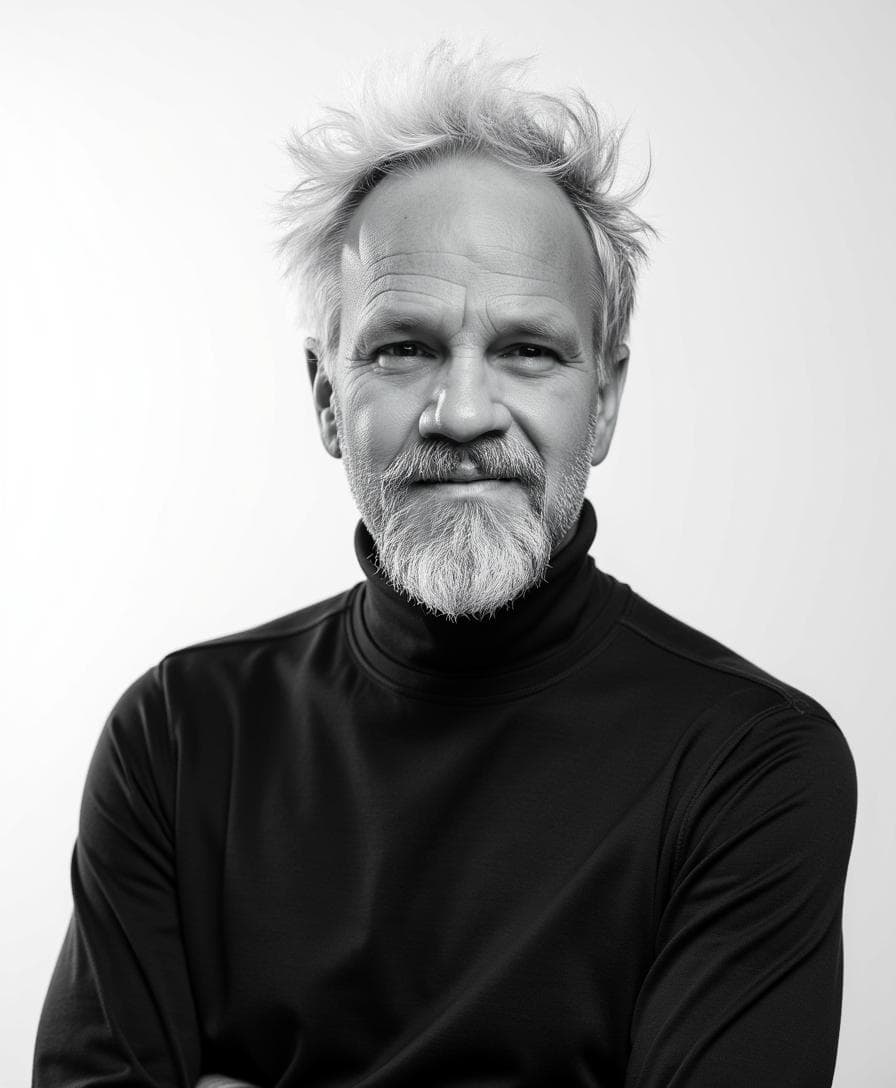
My StoryA Life Driven by Curiosity, Conviction, and the Courage to Question

Bryan Ferre

I've spent much of my life asking questions that don't always have convenient answers. Why do we believe the things we believe? What makes an idea worth pursuing? Why do some people see possibilities where others see limitations? And perhaps most importantly, how much of what we think we know is actually true?

These questions have shaped the way I approach nearly everything, from business and technology to philosophy, relationships, and the decisions that define our lives.

My story isn't one of following a carefully constructed plan. It's a story of curiosity, reinvention, ambition, mistakes, discovery, and an enduring belief that the world is far more interesting and full of possibility than we often allow ourselves to imagine.

I've been an entrepreneur, a designer, a strategist, an author, a researcher, and a builder of technology. I've helped create companies, explored emerging industries, developed new ideas, and worked alongside people with extraordinary talents and perspectives.

But I don't believe those titles explain very much about who I am.

What connects these experiences is something more fundamental: I've always wanted to understand how things work, why they work the way they do, and whether there might be a better way.

The Beginning of a Creative LifeLearning to See What Others Might Overlook

1991

My professional journey began in the creative world, where I discovered that design was about much more than making something visually appealing.

Design taught me to observe, question, simplify, and communicate. It taught me that every meaningful creation begins with understanding a problem and imagining a possibility that doesn't yet exist.

I studied graphic design at Al Collins Graphic Design School, earning an associate degree in 1991. At the time, I couldn't have anticipated how important that foundation would become to nearly everything I would do afterward.

The tools have changed dramatically since then, but the underlying principles remain remarkably consistent. Whether designing a visual identity, developing a business strategy, or architecting an intelligent software system, the process begins with recognizing relationships, identifying constraints, and creating something coherent from complexity.

Over time, my interests expanded beyond design into branding, marketing, business development, and the creation of new ventures. I became increasingly fascinated by the relationship between an idea and the systems required to bring it into the world.

I began to understand that creativity wasn't confined to art or design. It was equally present in entrepreneurship, technology, organizational strategy, and scientific exploration.

That realization changed the direction of my life.

Becoming an EntrepreneurThe Difference Between Having an Idea and Building Something Real

2009

Entrepreneurship appealed to me because it offered an opportunity to turn imagination into reality.

An idea can be exciting, elegant, even revolutionary. But until someone is willing to test it against the practical demands of the world, it remains a possibility rather than an accomplishment.

Building businesses taught me the importance of execution, relationships, adaptability, and persistence. It also taught me that uncertainty is not an occasional inconvenience in entrepreneurship. It is a permanent condition.

Through Bryan Ferre Creative, which I established in 2009, and my involvement in other ventures, I worked across branding, product development, marketing, strategic planning, and emerging technology.

I found myself drawn to businesses at moments of transition, when established assumptions were being challenged and new technologies were creating opportunities that had not previously existed.

What interested me most wasn't simply the prospect of commercial success. It was the process of bringing together people, resources, ideas, and technologies to create something that had not existed before.

I've experienced the excitement of new ventures, the complexity of partnerships, the satisfaction of seeing ideas become working products, and the difficult lessons that come when expectations collide with reality.

Those experiences have made me more thoughtful about leadership, trust, governance, and the responsibilities that accompany building something with other people.

I have come to believe that good strategy requires more than intelligence or ambition. It requires the humility to recognize what you don't know, the discipline to examine your assumptions, and the willingness to change direction when the evidence demands it.

Discovering the Power of TechnologyFrom Creative Systems to Intelligent Systems

My interest in technology developed naturally from my work in design and entrepreneurship.

Technology has always fascinated me because of its ability to transform what individuals and organizations can accomplish. It allows us to extend human capabilities, connect ideas across distances, automate repetitive processes, and solve problems at scales that would otherwise be impossible.

But I've never been particularly interested in technology for its own sake.

What matters to me is what technology makes possible and how it changes the relationship between people, institutions, and the world around them.

Over the years, I became increasingly involved in software platforms, digital infrastructure, and the development of technology-driven businesses.

My work included projects involving blockchain networks, decentralized systems, and artificial intelligence.

Each experience introduced new technical challenges and new questions about the nature of trust, control, participation, and accountability.

I began to see that many of the most difficult problems in technology are not purely technical. They are questions about human behavior, incentives, governance, and the assumptions embedded in the systems we create.

That insight became especially important as my work moved into decentralized infrastructure.

Exploring DecentralizationRethinking Trust, Ownership, and Participation

Blockchain technology attracted my attention because it challenged several assumptions about how digital systems must operate.

Traditionally, most digital platforms depend on centralized organizations to establish trust, control access, maintain records, and determine how value is distributed. Blockchain introduced the possibility of coordinating some of these functions through distributed networks, transparent rules, and shared participation.

As a co-creator of Optio Blockchain, I became deeply involved in exploring how decentralized infrastructure could support new economic and organizational models.

My interests extended beyond cryptocurrencies and token markets. I wanted to understand how decentralized systems could encourage meaningful participation, distribute opportunities, and create new relationships between the people who build, maintain, and use digital networks.

This work introduced me to the complexities of consensus mechanisms, token economics, network incentives, node infrastructure, decentralized governance, and the relationship between technical architecture and human decision-making.

It also reinforced an important lesson: decentralization is not automatically synonymous with fairness, transparency, or accountability.

The rules of a system matter. The people who control those rules matter. And the mechanisms through which those rules can be changed may be just as important as the technology itself.

These questions continue to influence my research into blockchain, governance, and the design of trustworthy digital systems.

The Questions Behind the TechnologyWhy I Became Increasingly Interested in Philosophy

Throughout my professional life, I've been drawn to philosophical questions, particularly those involving knowledge, perception, certainty, and human understanding.

I began to recognize how frequently people confuse familiarity with knowledge and confidence with accuracy.

We inherit beliefs from our families, cultures, educational institutions, professional environments, and personal experiences. Over time, these beliefs become the frameworks through which we interpret reality.

Those frameworks are necessary. Without them, navigating the world would be extraordinarily difficult.

But they can also become limitations.

When we become too attached to what we believe we know, we may stop asking the questions that would allow us to understand something more deeply.

This tension between knowledge and certainty became a central theme in my writing.

The Myth of Knowing

The Myth of Knowing grew out of my interest in the assumptions that shape human understanding.

The work explores the possibility that what we call knowledge is often a complicated mixture of observation, interpretation, belief, experience, and inherited explanation.

I'm interested in the difference between possessing information and genuinely understanding something.

Information can be collected, memorized, and repeated. Understanding requires us to examine relationships, recognize uncertainty, question our conclusions, and remain open to perspectives that challenge our existing beliefs.

I don't believe the answer is to reject knowledge or abandon the pursuit of truth. Quite the opposite.

I believe the pursuit of truth requires intellectual humility.

The more deeply we examine the world, the more we discover how much remains unexplained.

For me, that realization isn't discouraging. It's liberating.

It means there is always something more to learn.

Thinking Differently About StrategyFrom Linear Planning to Interconnected Possibilities

My interest in philosophy and complex systems also influenced my thinking about business strategy.

Traditional strategic planning often assumes that the future can be approached through relatively predictable sequences of decisions and outcomes.

But the world rarely behaves so neatly.

Organizations operate within interconnected environments where technology, markets, human behavior, regulation, and unexpected events continually influence one another.

A decision made in one part of a system can produce consequences somewhere entirely different. Opportunities can emerge from relationships that were previously invisible. And assumptions that seemed reasonable yesterday can become obsolete tomorrow.

These ideas helped shape Quantum Strategy, my exploration of strategic thinking in complex and uncertain environments.

The work reflects my belief that strategy should not simply be about choosing a destination and following a predetermined route.

It should also be about developing the capacity to recognize emerging possibilities, understand interconnected systems, and adapt intelligently as conditions change.

I see strategy as an ongoing process of observation, interpretation, experimentation, and learning.

In that sense, it is closely related to the philosophical questions that have occupied so much of my thinking.

Both begin by questioning what we assume to be true.

Artificial Intelligence and the Next FrontierBuilding Systems That Extend Human Capability

Today

Artificial intelligence has brought many of my interests together in ways I find particularly compelling.

For decades, software has allowed us to automate processes and manage information. Artificial intelligence introduces something fundamentally different: systems capable of interpreting language, generating ideas, identifying patterns, and participating in complex cognitive workflows.

The possibilities are extraordinary, but so are the challenges.

Generative AI systems can produce remarkably convincing outputs without necessarily possessing a reliable understanding of whether those outputs are correct.

That creates a fundamental problem when AI is used in environments where accuracy, evidence, accountability, and professional judgment are essential.

I became interested in how intelligent systems could be designed to address these limitations through architecture rather than relying exclusively on increasingly capable models.

Codira and the Architecture of Accountable Intelligence

As founder and CEO of Codira, I am working with a team to develop software systems built around a different approach to artificial intelligence.

Our architecture coordinates specialized AI agents within structured workflows, supported by deterministic validation, source verification, and human oversight.

The objective is not simply to make AI generate more content or complete tasks more quickly. It is to make intelligent systems more dependable, understandable, and useful in environments where mistakes have consequences.

Codira began with software development tools and has expanded into professional applications, including legal technology and other specialized industries.

For me, this work represents a convergence of many ideas I've explored throughout my career: systems thinking, creative problem-solving, governance, human judgment, technology, and the importance of questioning assumptions.

It also raises fascinating philosophical questions.

What does it mean for a machine to reason? How should we evaluate the reliability of an intelligent system? What responsibilities must remain with human beings? And how do we design technology that strengthens human agency rather than diminishing it?

I expect these questions to occupy much of my attention for years to come.

The Value of ReinventionWhy I Don't Believe We Should Ever Stop Beginning Again

One of the recurring themes in my life has been reinvention.

I've moved between creative disciplines, business development, technology, research, and writing, often entering fields where I had much more to learn than I already understood.

I don't see that as a disadvantage.

In fact, I believe the willingness to become a beginner again is one of the most valuable qualities a person can develop.

Experience is important, but experience can also create intellectual habits that make it difficult to recognize unfamiliar possibilities.

Sometimes the most productive question comes from someone who hasn't yet learned why a particular problem is supposedly impossible to solve.

I've found that moving between disciplines often reveals connections that are less obvious to people working entirely within one field.

A concept from philosophy can illuminate a problem in artificial intelligence. A principle from design can improve organizational strategy. A lesson from entrepreneurship can reveal a weakness in technical governance.

These connections are part of what makes interdisciplinary thinking so valuable to me.

I don't believe curiosity should diminish with age, nor do I believe education should end when formal schooling does.

The world is too complex, and life is too interesting, to stop learning.

Lessons That Changed My PerspectiveSuccess, Failure, Trust, and the Complexity of Human Relationships

No honest account of an entrepreneurial life would be complete without acknowledging its difficulties.

Building businesses and pursuing ambitious ideas can be enormously rewarding, but the process also exposes us to uncertainty, disappointment, disagreements, and circumstances we cannot fully control.

I've experienced professional successes and setbacks, productive partnerships and difficult relationships, ambitious plans that became reality and others that did not unfold as expected.

Those experiences have influenced my understanding of leadership and the responsibilities we have to one another.

I've learned that trust is essential but should never be confused with the absence of accountability. That enthusiasm must be balanced with disciplined examination. That good intentions do not guarantee good outcomes. And that the way people respond to adversity often reveals more about their character than the way they behave when everything is going well.

I've also learned that perspective changes with experience.

Situations that once seemed simple become more complicated when we understand the people, incentives, and circumstances involved.

I don't pretend to have navigated every challenge perfectly. I've made decisions I would approach differently today, and I've learned lessons that could not have been acquired through books or theory alone.

What matters to me is the willingness to learn from those experiences without allowing them to define the limits of what comes next.

I believe resilience is not simply the ability to endure difficulty. It is the capacity to remain thoughtful, constructive, and open to possibility after encountering it.

The Work Is Never Really FinishedResearch, Writing, and the Pursuit of Understanding

As my professional interests have expanded, I've become increasingly committed to documenting the ideas and questions that emerge from my work.

I see research and writing as essential parts of that process.

Writing forces us to organize our thoughts, examine contradictions, and confront the weaknesses in our own reasoning. It also creates an opportunity for other people to evaluate, challenge, and build upon our ideas.

My interests continue to span artificial intelligence, decentralized systems, philosophy, entrepreneurship, education, governance, human behavior, and emerging technologies.

I don't approach all of these subjects as someone who possesses definitive answers. I approach them as someone who believes the questions are worth exploring.

Some of my work involves practical technologies and products. Other projects are conceptual investigations into ideas that may take years to develop.

I believe both forms of exploration have value.

Innovation often begins long before there is a business model, a market, or even a clear application.

Sometimes it begins with nothing more than an observation that challenges what everyone else has accepted.

What I BelieveA Few Principles That Continue to Guide Me

Curiosity Is More Valuable Than Certainty

The willingness to ask questions opens possibilities that unquestioned confidence can conceal. I would rather discover that I was mistaken than defend an idea simply because it has become familiar.

Ideas Matter, but Execution Gives Them Meaning

An idea can inspire, but creating something useful requires discipline, collaboration, persistence, and a willingness to confront practical realities.

Human Judgment Must Remain Central

Technology should extend our capabilities without relieving us of responsibility. The more powerful our systems become, the more important accountability, transparency, and thoughtful oversight become.

Trust Requires Structure

Good intentions and personal relationships are important, but durable institutions also need clear rules, appropriate safeguards, and mechanisms for accountability.

Learning Should Never End

I believe intellectual growth is a lifelong responsibility. Experience should deepen our curiosity rather than convince us that we have nothing left to discover.

The Future Is Not Something We Simply Inherit

The decisions we make, the systems we build, and the assumptions we challenge all influence what becomes possible. We have a responsibility to approach that work thoughtfully.

Still Curious. Still Building.Still Learning.

I don't know exactly where my interests will lead next.

There are technologies I want to explore, books I want to write, questions I want to investigate, and ideas I hope to turn into meaningful contributions.

What I do know is that I have never been comfortable accepting the world exactly as it is simply because that's how I've encountered it.

I remain fascinated by the relationship between human understanding and technological possibility. I'm interested in how we build better institutions, create more accountable systems, and develop tools that allow people to accomplish things that once seemed impossible.

And I continue to believe that many of the most important discoveries begin with the simplest of questions.

What if we're looking at this the wrong way?

That question has accompanied me through much of my life.

I suspect it always will.

Continue Exploring